- Sewer Services > Renovation > Partial rehabilitation
Partial rehabilitation
Main pipes and pipe sections
Rehabilitating leaks permanently with partial repair pieces (short liners)
Today, in many cases, trenchless rehabilitation allows us to repair leaking sewers properly from within without tearing up the ground, a road surface or a square. Indirect costs and limitations caused by impairing traffic and harm caused by noise and pollution are significantly reduced or completely circumvented. The costs of rehabilitation measures can thus be significantly reduced.
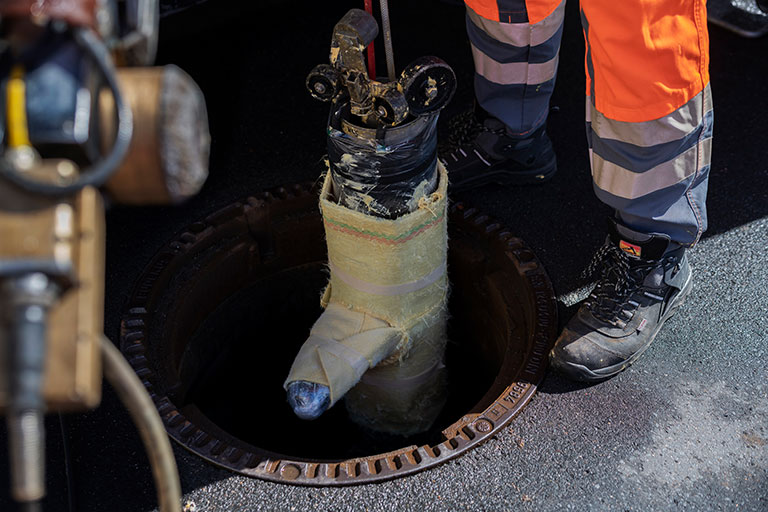
The fiberglass repair piece is saturated with synthetic resin and pressed into the repair point from the inside using a packer. The packer is positioned by a robot which moves it to the repair point within the pipe. Once the resin has hardened, the short liner and sewer pipe form a permanent bond. In this way, leaks in pipes and sockets can be fixed very effectively. Application scenarios are damage profiles such as tears, fragment formation and leaking sockets. The requirement for partial rehabilitation is the general stability of the sewer section being renovated. From a size of DN 200, the packers have sufficient flow so that they can work during active sewer operations. Today, renovation technologies are globally recognized sewer repair processes.
Summary
Proper installation of short liners into
- Main pipes from DN 100 to DN 800
- House connection lines
Materials
- Short liners made from fiberglass and synthetic resin
Preparatory and follow-up work
- High-pressure jet
- Milling and cleaning
- TV inspection and final check
- Execution by trained, skilled personnel
Click here to activate marketing cookies and display external content from Youtube.
Mark of Quality in Sewer Construction
Schwalm Kanalsanierung bears the Sewer Construction Mark of Quality.
The quality assurance RAL-GZ 961 applies to the manufacture and maintenance of public and private wastewater pipelines and sewers.
